

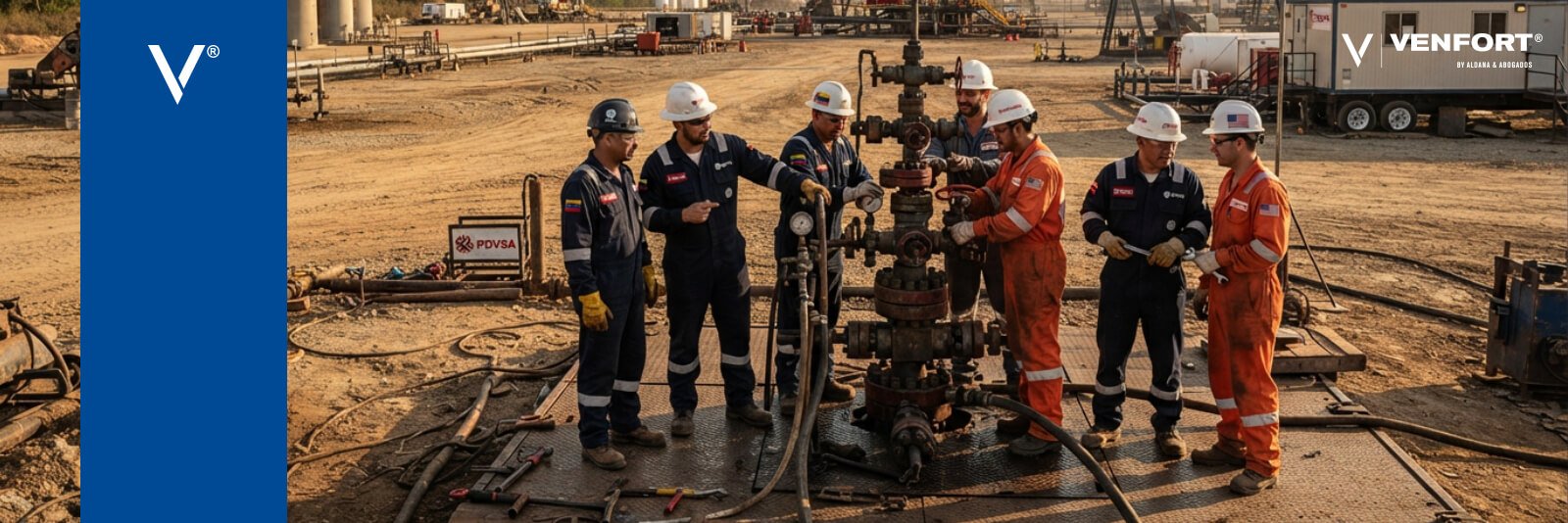
An analytical approach to the August 28 announcement and the technical, regulatory, and market conditions that will determine its actual effectiveness.
By Dr. Pedro Baute · Managing Partner of the Energy Practice at VENFORT Abogados
The framework agreement on energy between the United States of America and Venezuela, announced by President Donald Trump on August 28 and confirmed the following day by acting president Delcy Rodríguez—seventeen oil fields, a proven potential of 65 billion barrels, an investment exceeding 100 billion dollars, and operational horizons of up to twenty-five years—constitutes one of the most prominent geoeconomic events for this part of the hemisphere in the last decade. However, a rigorous analytical approach requires separating political-communicational expectations from the conditions of technical, regulatory, and market viability that will determine its real effectiveness.
To date, neither the regulatory text nor the contractual annexes have been published, and the two official versions differ: Caracas speaks of twenty-five years; the White House factsheet of August 31 speaks of «one-hundred-year concessions» to a private operator with US government participation. The evaluation must therefore be carried out in light of the pre-existing legal framework and the structural variables of the international oil industry.
1. The legal and constitutional framework: limits and inalienability of deposits
From a public law perspective, one of the central premises for any understanding on the matter lies in the ownership regime of hydrocarbon reserves. Contrary to preliminary interpretations that might suggest a direct transfer of control over the deposits, it is observed that the Venezuelan constitutional framework—specifically in its Article 12—unequivocally establishes that hydrocarbon deposits «are public domain assets and, therefore, inalienable and imprescriptible.».
Therefore, any international cooperation scheme, regardless of its geopolitical scope, is restricted to the granting of contractual exploitation rights and equity stakes in joint ventures or in contracts with private operators. This is confirmed by the Organic Hydrocarbons Law reformed in January 2026 (Extraordinary Official Gazette No. 6,978): it sets the duration of joint ventures at twenty-five years, renewable (Art. 35); permits private operators domiciled in Venezuela (Art. 23); guarantees the economic equilibrium of contracts (Art. 26); allows arbitration (Art. 8), and reopens services ancillary to petroleum activity to private capital. Sovereignty over the subsoil resource thus remains under the exclusive ownership of the Venezuelan State, and any private or foreign state association is conditioned upon compliance with current constitutional and legislative procedures.
2. Infrastructure, refining, and the value chain
On a strictly operational level, the feasibility of the outlined objectives—raising production above 1.5 million barrels per day, when OPEC currently places it at around 1.1 million—faces structural constraints in the energy value chain. The extra-heavy crude oils from the Orinoco Oil Belt require complex infrastructure for their extraction, processing, and transportation, which depends on the continuous supply of diluents and the optimal functioning of upgraders.
In this sense, although the refineries located in the Gulf of Mexico constitute the natural technical and geographic destination for this type of crude, the sustained reactivation of export supply would require the following:
- Intensive investment in fixed capital: repair of critical transportation, storage, and shipping terminal infrastructure.
- Specialized human capital: reintegration and consolidation of technical staff for operational and refining management.
- Temporal graduality: Operational projections estimate that technical and logistical adaptation could require a transition window of between 18 and 24 months before consolidating significant increases in export flows.
3. Market incentives and global capital behavior
The bilateral understanding responds to interconnected strategic interests: the pursuit of stability in the supply of heavy crude to hemispheric markets and the need to boost foreign exchange earnings and foreign direct investment.
However, the massive investment flow from major international oil corporations is contingent upon the consolidation of predictable institutional conditions. Even with the new Organic Hydrocarbons Law, the attraction of long-term capital requires clear regulatory frameworks —transparent licenses, legal certainty and fiscal stability— and financial guaranteesinvestment protection, capital repatriation, and ideal mechanisms for resolving international disputes. Added to this is the United States sanctions regime, which remains in force although eased by OFAC through general licenses; each transaction must be structured in accordance with the corresponding license.
4. Price dynamics and financial risk management
Official estimates project investments exceeding 100 billion dollars and revenues for the Venezuelan State of close to 209 billion during the term of the agreement, calculated at 65 dollars per barrel, below the OPEC basket average in July (82.99 dollars). However, effective profitability and fiscal performance will be inherently subject to global market dynamics: the net return per barrel will depend on the reference price, dilution and input costs, and quality differentials, while the pace of execution will depend on the liquidity of the consortia and their ability to structure debt in international markets.
5. The opportunity for the Caribbean
A plan of that magnitude is not executed by seventeen fields, but by thousands of contracts for drilling, well services, diluents, transportation, storage, power generation, engineering, logistics, and supplies. The Dominican Republic, which has known Venezuelan crude since Petrocaribe and Refidomsa and has ports, free trade zones, and a business community accustomed to the dollar, can position its service companies as second-tier suppliers to those who will operate the fields.
Final consideration
The technical complementarity and geographical proximity between the Venezuelan resource base and the US refining system continue to be a crucial factor. However, the transformation of a framework agreement into a vehicle for sustainable energy development will depend on the final design of its regulatory instruments, the strict observance of constitutional guarantees, and the implementation of instruments that ensure transparency, predictability, and operational certainty over time.
VENFORT Abogados supports this process from Madrid and Caracas. Its Energy department, led by the author—former corporate manager of Major Projects for PDVSA's Legal Consultancy—knows the Venezuelan industry from the inside and structures joint ventures, contracts with private operators, and service contracts under the new law, complemented by a practice specialized in OFAC sanctions that makes it possible to frame each transaction within the corresponding general license and comply with its payment and reporting conditions. Investing in Venezuela It is possible again; doing so with legal certainty is what distinguishes an opportunity from a problem. Contact us for more information.
Sources
White House, «Fact Sheet: President Donald J. Trump Announces Historic Oil Agreement…», Aug 31, 2026 · Message from the acting president of Venezuela, VTV, Aug 29, 2026 (EFE; Listín Diario, Aug 30, 2026) · Official Gazette of the Bolivarian Republic of Venezuela No. 6.978 Ext. (Jan 29, 2026), No. 7.052 Ext. (Jul 7, 2026) and No. 43.410 · OFAC, Venezuela-related General Licenses and FAQ 1247 and 1267 (Mar 31, 2026 and Aug 27, 2026); Executive Order 14373 (Jan 9, 2026) · OPEC, Monthly Oil Market Report, August 2026 · EIA, weekly crude oil imports · Constitution of the Bolivarian Republic of Venezuela, arts. 12, 150, 151, 154, 258, 302 and 303 · BOE No. 245, Oct 13, 1997 (Spain–Venezuela BIT).

Head of the Energy practice at VENFORT Abogados (Madrid — Caracas). Expert in oil and financial law. Former Corporate Manager of Major Projects for PDVSA's Legal Department. Admitted to practice in Spain and Venezuela.