

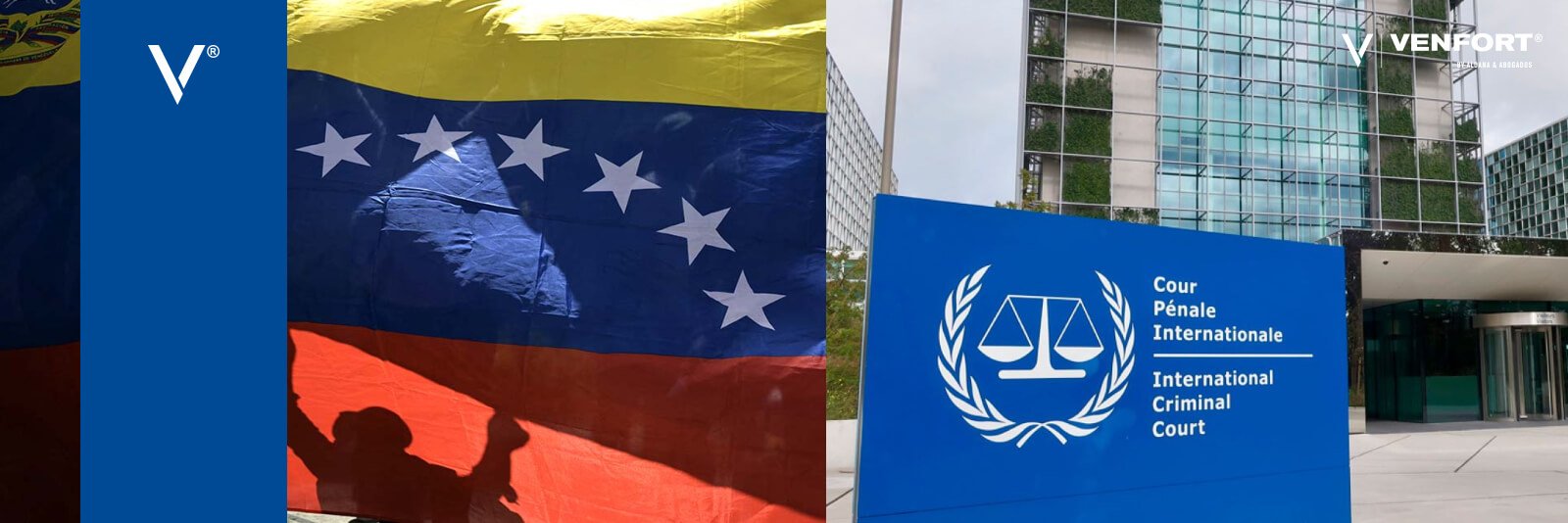
The question that many former officials and their families with exposure in the Venezuela I case were asking themselves hypothetically stopped being so this week. On July 24, 2026, Foreign Minister Félix Plasencia formally notified the Secretary-General of the United Nations, António Guterres, of the denunciation of the Rome Statute by the Bolivarian Republic of Venezuela. The decision, backed by a prior law from the National Assembly that repealed the approval of the treaty, activates a legal mechanism—the withdrawal from the International Criminal Court (ICC)—that only one State, Burundi, and a reversed attempt, the Philippines, had executed before.
The intuitive reaction of many readers will be to think that the withdrawal «closes the door» on the ICC and dissolves any risk associated with ongoing investigations. This is precisely the mistake that the most recent and best-documented precedent—that of the Philippines—disproves with almost didactic clarity. This article explains, with technical rigor and without alarmism, what actually changes and what does not.
Article 127 of the Rome Statute: what withdrawal can and cannot do
Article 127.1 of the Rome Statute allows any State Party to withdraw by written notification to the UN Secretary-General. The withdrawal takes effect one year after the date the notification is received, unless a later date is specified. In the Venezuelan case, with the notification deposited around July 24–26, 2026, the withdrawal would be legally effective around July 2027. During that year, Venezuela remains, for all purposes, a State Party to the Rome Statute, with all of its obligations in full force.
“Article 127.2” is the provision that truly matters for anyone who is under investigation or fears being so. It explicitly establishes that the withdrawing State “shall not be released, by reason of its withdrawal, from the obligations arising from this Statute while it was a Party,” and that the withdrawal “shall not affect any cooperation with the Court in connection with criminal investigations and proceedings... commenced prior to the date on which the withdrawal became effective,” nor shall it prejudice in any way the consideration of any matter which was already under examination by the Court prior to that date.
Put simply: withdrawal is not an eraser. It does not archive what is already open. It only prevents the ICC from opening new cases for events that occurred after the withdrawal takes effect.
The Philippine precedent: the ICC has already resolved this doubt
The Philippines notified its withdrawal from the Rome Statute on March 17, 2018; the withdrawal became effective on March 17, 2019. President Rodrigo Duterte, promoter of the measure, calculated —as many advisors do today regarding other countries— that the exit would shield his government from the investigation that the ICC Prosecutor was already examining for the so-called «war on drugs».
The calculation failed. On September 15, 2021, Pre-Trial Chamber I authorized the opening of a formal investigation into crimes against humanity allegedly committed in the Philippines between 2011 and 2019, that is, during the period when the country was a State Party. On October 23, 2025, the same Chamber expressly confirmed that the Court retained jurisdiction despite the withdrawal, and on April 23, 2026, the Appeals Chamber ratified that conclusion: interpreting the Statute in a way that would allow a State to escape its obligations by withdrawing after an investigation was already underway would contradict the object and purpose of the treaty itself.
Duterte was detained at the Manila International Airport on March 11, 2025, in execution of an ICC arrest warrant notified through INTERPOL, and transferred that same night to The Hague. The Philippines—the same State that had withdrawn six years earlier—carried out the handover. In April 2026, the Pre-Trial Chamber confirmed the charges of crimes against humanity against him, referring the case to trial.
The other high-ranking Filipino official: The Ronald dela Rosa case
The Filipino precedent does not end with Duterte. On May 10-11, 2026, the ICC made public an arrest warrant issued against “Ronald Marapon Dela Rosa,” former chief of the Philippine National Police and operational enforcer of the anti-drug campaign, later elected senator of the Republic. The warrant names him, along with other alleged co-perpetrators, for crimes against humanity linked to the same situation investigated regarding Duterte.
The attempt to execute the arrest inside the Philippine Senate building itself, on May 13, 2026, led to a confusing incident from which dela Rosa managed to evade capture, remaining in an unknown location ever since. Days later, the Supreme Court of the Philippines rejected his request for an injunction against the validity of the ICC warrant, and the Philippine Executive branch itself publicly reiterated its willingness to cooperate with the Court for his eventual surrender.
The case starkly illustrates two things: first, that neither a change of position —from police chief to senator— nor the very withdrawal of the State of origin from the Rome Statute neutralizes an arrest warrant already issued for prior acts; second, that the execution of those orders ultimately depends on the political will of the moment, which introduces an element of uncertainty that no serious defense strategy can ignore.
Venezuela before the ICC: two active situations and a third variable now in play
Venezuela ratified the Rome Statute in June 2000. Since then, two proceedings with different origins and logic have coexisted before the Court.
“Situation Venezuela I” was referred to the ICC in September 2018 by a group of States—Argentina, Canada, Colombia, Chile, Paraguay, and Peru—to which Uruguay (2024) and Ecuador (2025) subsequently added. The preliminary examination concluded in November 2021 with the finding that there was a reasonable basis to believe that crimes against humanity had been committed since April 2017. Venezuela requested the deferral of the investigation pursuant to Article 18.1 of the Statute, claiming that it was internally investigating the same facts. Pre-Trial Chamber I rejected that request on June 27, 2023, authorizing the resumption of the investigation upon concluding that domestic proceedings did not cover the contextual elements of the crime against humanity nor the potential superior command responsibility. The Appeals Chamber confirmed that decision on March 1, 2024. To date, there is no public record of any arrest warrant issued within the framework of this situation, but it cannot be ruled out that alerts or active notices might currently exist, as occurred in the case of former President Duterte and the police chief of the Philippines.
The “Venezuela Situation II” has an inverse origin: it was the Venezuelan State itself that, in February 2020, self-referred to the ICC Prosecutor's Office to denounce the effect of unilateral coercive measures imposed by the United States. This case is now archived due to the dismissal by the prosecutor of the International Criminal Court.
Against this backdrop, the variable of the withdrawal notified in July 2026 is now projected. And this is where the Philippine precedent becomes directly relevant to any serious analysis: given that Situation I was formally opened in 2018 —years before the withdrawal becomes effective in 2027— the Court will predictably retain jurisdiction over the facts already under its consideration, by exact application of the same reasoning that the Appeals Chamber applied to the Philippines. The Venezuelan withdrawal does not erase what has already been initiated; at best, for those seeking protection, it limits the opening of new fronts for future conduct.
What does change with retirement, and what does not
What does not change: the investigations already opened —Situation I, in particular— continue their course. Venezuela's obligation to cooperate regarding these proceedings remains in force throughout the year leading up to the effective withdrawal, and —according to the Filipino precedent— the Court's jurisdiction over those specific facts could survive even afterwards. Any person exposed in the facts investigated in Situation I does not obtain, simply due to the State's withdrawal, a supervening immunity.
What does change: starting from the moment the withdrawal becomes effective. July 2027, the ICC will not be able to open new investigations regarding conduct after that date, unless other avenues of jurisdiction apply. The willingness of the Venezuelan State to cooperate actively with the Court —surrender of investigated persons, access to evidence, execution of orders— is evidently weakened in political terms, although legally it remains bound during the transition period.
For anyone assessing their personal exposure, the practical conclusion is twofold: withdrawal does not offer an automatic shield regarding what has already been investigated, and the uncertainty regarding how cooperation obligations will be executed in practice during and after the transition requires, precisely, permanent legal monitoring rather than an optimistic reading of press headlines.
Frequently asked questions
- Has Venezuela already withdrawn from the International Criminal Court or did it only announce it? Venezuela formally notified the UN of its withdrawal in July 2026. Pursuant to Article 127.1 of the Rome Statute, the withdrawal will become legally effective one year after that notification, that is, around July 2027. Until then, Venezuela remains a State Party with full obligations.
- Does the withdrawal archive the investigations already opened against Venezuela? No. Article 127.2 of the Statute and the precedent confirmed by the ICC Appeals Chamber in the Philippines case establish that withdrawal does not affect investigations already initiated before it takes effect.
- Can the ICC arrest someone in Venezuela after the withdrawal? The material execution depends on the cooperation of the State where the person is located. The Duterte case shows that, even years after withdrawal, a State may end up executing an ICC warrant if political circumstances change; even this year, 2026, within the Philippine Senate, a police procedure was carried out to arrest the former police chief.
- What should someone with potential exposure do during these procedures? Obtain an individualized legal diagnosis of your situation regarding both open situations before the ICC, without assuming that the State's withdrawal resolves your personal exposure on its own. Likewise, you must take preventive actions before the Interpol Commission for the Control of Files aimed at protecting you from international arrest.
Conclusion
A State's withdrawal from the Rome Statute is, on paper, a sovereign decision with full backing in international law. In practice—and the International Criminal Court itself has confirmed this in the most recent and best-documented precedent available—it is not an escape route for what is already under investigation. Anyone advising on the basis that «Venezuela is no longer in the ICC, so there is no risk» is offering an incomplete and potentially dangerous reading of a legal phenomenon that demands nuance.
The simultaneous monitoring of proceedings before international courts and national jurisdictions, with direct knowledge of the procedural developments in The Hague and internal Venezuelan dynamics, is essential for any individual or family with real exposure in this scenario.
VENFORT By Aldana & Abogados · Madrid · Caracas · Presence in 15 jurisdictions
International criminal defense · International Criminal Court · Extraditions · Sanctions · Corporate lawfare.
Contact us.

Founding partner and Director of the International Criminal Law Department at VENFORT Lawyers. Lawyer accredited before the International Criminal Court, with over twenty years of practice in extraditions, INTERPOL proceedings, economic criminal law, and international sanctions, assists entrepreneurs, executives, institutions, and families with interests in Europe and the Americas.