

Venezuelan oil activity is once again in the spotlight for international investors and operators. The changes in the regulatory framework of the sector, along with the opportunities offered by the opening up to private investment, present new scenarios for companies interested in developing, expanding, or consolidating their presence in the country.
However, alongside the Business and investment opportunities, There are legal risks that require special attention. Among them, the possible criminal liability arising from the decisions adopted during the negotiation, structuring, and execution of contracts related to the hydrocarbons sector stands out.
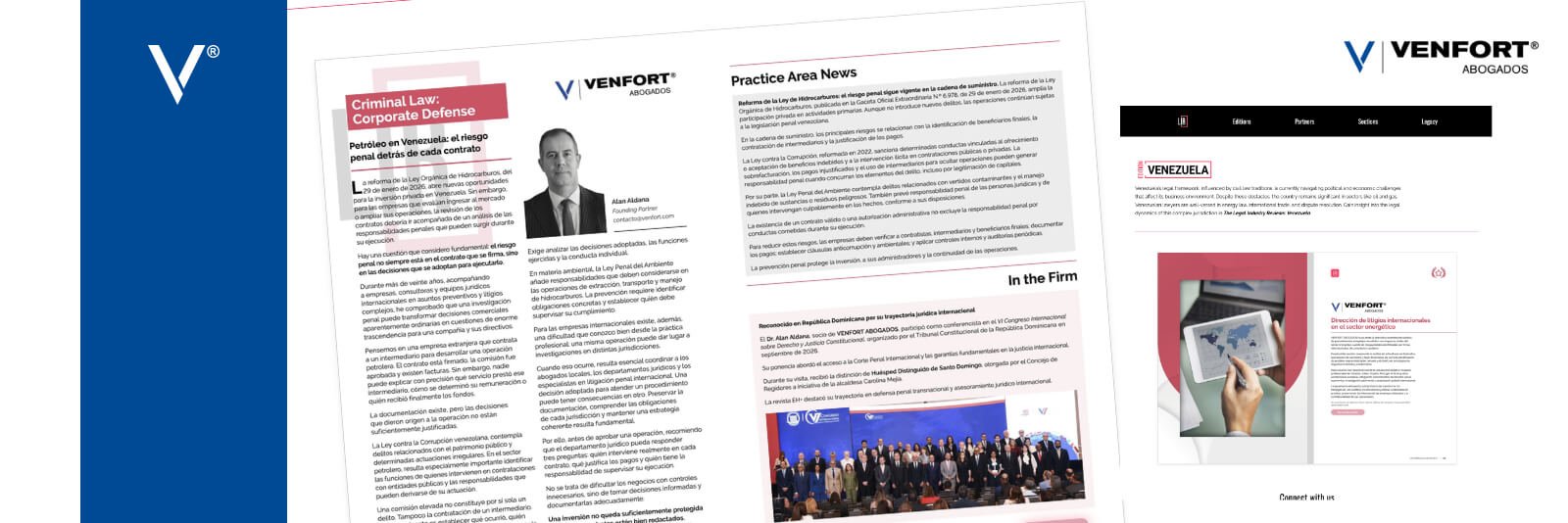
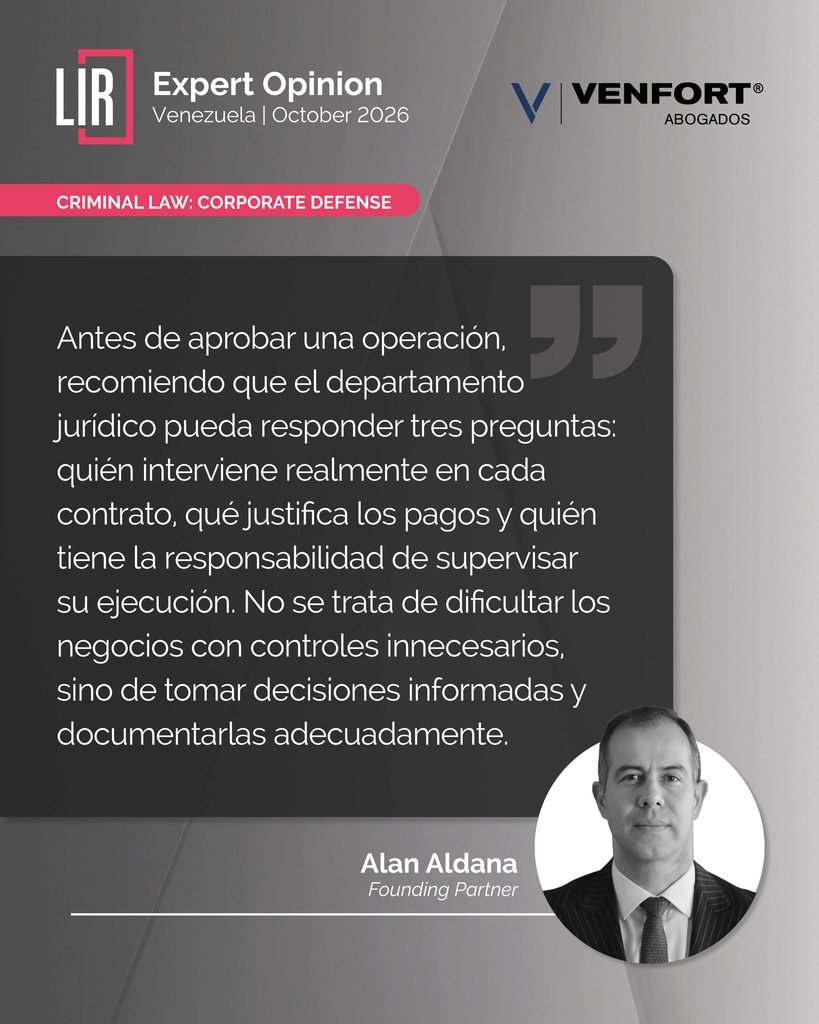
This is precisely the question addressed by Dr. Alan Aldana, founding partner of VENFORT ABOGADOS, in his article «Oil in Venezuela: the criminal risk behind each contract», published in the seventh edition of The Legal Industry Reviews: Venezuela, On pages 20 and 21.
The reform of the oil sector and its legal implications
The reform of the Organic Law on Hydrocarbons of January 29, 2026, opens new opportunities for private investment in Venezuela. This scenario requires companies interested in participating in the energy market to evaluate not only the contractual and commercial conditions of their operations, but also the possible legal liabilities that may arise during their execution.
As Dr. Aldana points out, the criminal risk is not always found in the contract that is signed, but in the decisions that are taken to execute it.
An operation may have formalized contracts, invoices, and commercial authorizations, and yet still present elements that could lead to criminal investigation. For example, when it is not possible to properly justify the services provided by an intermediary, the criteria used to determine their fees or the final destination of the funds involved.
From this perspective, prevention requires examining the economic reality of each operation, the documentation that supports it, and the behavior of the people involved in it.
Main criminal risks in oil operations
The analysis published by Dr. Aldana identifies several areas that deserve special attention from companies, their managers, and the teams responsible for operations.
1. Intermediaries, commissions and payments to third parties
The hiring of intermediaries constitutes one of the aspects that require the greatest diligence. Companies must be able to prove the necessity of the contracted services, their effective provision, and the reasonableness of the agreed remuneration.
The existence of invoices or contracts does not replace the need to justify the economic basis for the payments or to identify their final beneficiaries.
2. Corruption and undue benefits
Anti-corruption regulations and corporate integrity obligations take on special importance in relationships with contractors, suppliers, intermediaries, and other participants in the supply chain.
Situations that can lead to criminal exposure include accepting or providing improper benefits, making unjustified payments, and certain practices of overbilling.
Therefore, internal control mechanisms, the traceability of payments, and third-party monitoring must be part of the risk prevention strategy.
3. Criminal liability of the persons involved in the operation
An investigation is not necessarily limited to the commercial society involved. The actions of managers, executives, representatives, hiring managers and other professionals may be examined individually.
It is essential to identify who made each decision, what functions they performed, what information was available to them, and what their effective involvement in the operation was.
4. Environmental risks and obligations in the management of hydrocarbons
The environmental dimension also plays an important role in the analysis. The Environmental Penal Code includes legal consequences related to certain behaviors associated with the improper handling of hazardous substances and waste, among other activities.
Companies must pay attention to the obligations applicable to the extraction, transport, storage and management of hydrocarbons, as well as to the controls designed to prevent environmental violations.
5. Legal exposure in different jurisdictions
International energy operations often involve companies, suppliers, financial institutions, and intermediaries established in different countries.
This structure can lead to parallel investigations or proceedings in different jurisdictions. Therefore, the prevention and defense strategy must include international legal coordination, the preservation of documentation, and the assessment of potential responsibilities in each territory.
Criminal prevention as a tool for business protection
For companies involved in the Venezuelan energy sector, the management of criminal risk must be integrated into the planning of their operations, and not limited to a legal review following the occurrence of a conflict.
An adequate preventive strategy requires, among other actions:
- Review contracts and intermediary structures before finalizing transactions.
- Verify the identity, activity, and legitimacy of the third parties involved.
- Documenting the economic justification for payments, commissions, and business decisions.
- Establish control mechanisms over the hiring processes and the supply chain.
- Identify the applicable environmental and regulatory obligations.
- Define the roles and responsibilities of administrators, managers, and operational teams.
- Evaluate the risks arising from the intervention of entities and individuals in different jurisdictions.
The purpose is not only to reduce the possibility of an investigation, but also to have a documentary and organizational basis that allows the legitimacy of business decisions to be proven.
VENFORT ABOGADOS: experience in international litigation in the energy sector
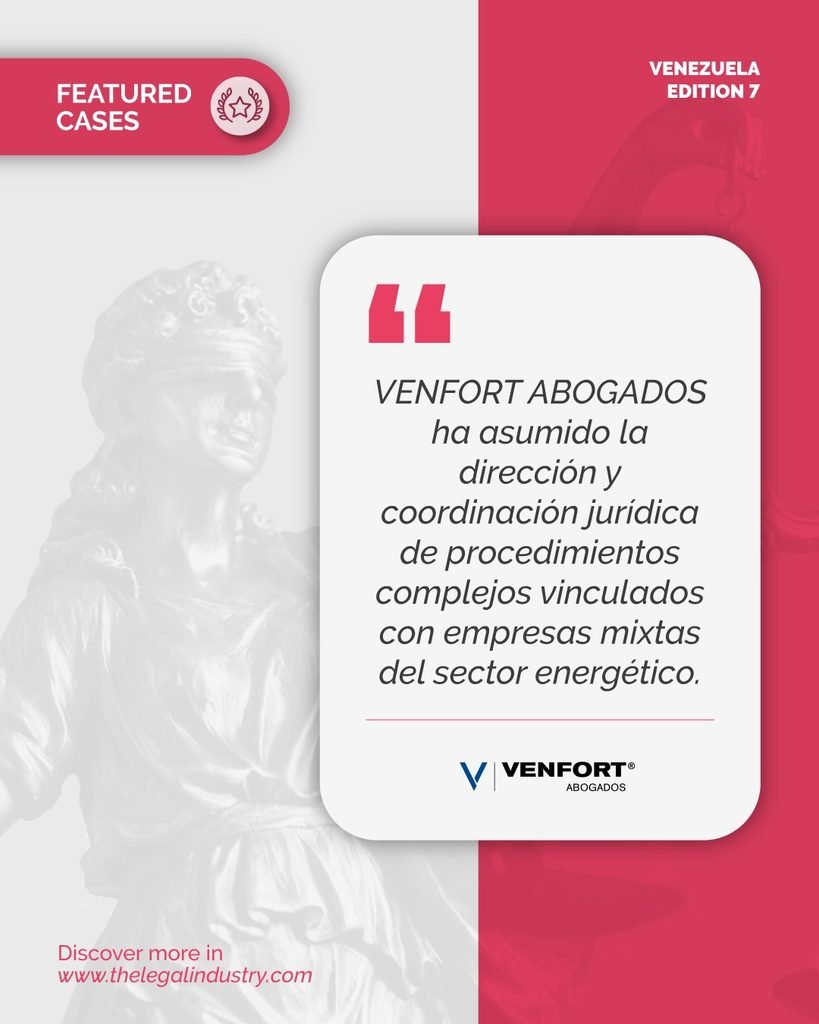
In this same edition of The Legal Industry Reviews: Venezuela, VENFORT ABOGADOS presents its experience in the management of international litigation related to the energy sector, on page 49.
The publication highlights our involvement in complex procedures related to supply and service operations in the energy sector, as well as the legal coordination of proceedings that may involve companies and professionals in different jurisdictions.
Our experience includes the analysis of contractual structures, the identification of potential liabilities, the coordination with local legal teams, and the preparation of defense strategies in scenarios of special complexity.
This work requires a comprehensive vision that combines knowledge of criminal law, sectoral regulation, the corporate dimension, and the specificities of international procedures.
A rigorous legal assessment before investing
The opportunities presented by the Venezuelan oil sector require business decisions supported by sufficient information and a rigorous assessment of the risks.
For entrepreneurs, investors, and executives, understanding the potential criminal implications of an operation is essential to protect their interests, preserve the continuity of their businesses, and prevent seemingly routine business decisions from leading to broader legal consequences.
Criminal prevention should not be understood as an obstacle to investment, but as an essential condition for developing sustainable, transparent and legally protected operations.
See the full analysis by Dr. Alan Aldana in the seventh edition of The Legal Industry Reviews: Venezuela (pages 20 and 21), as well as the presentation of the experience of VENFORT ABOGADOS in international energy sector litigation (page 49).
Access the original edition of The Legal Industry Reviews: Venezuela
VENFORT LAWYERS
Confidentiality, responsibility and effectiveness.